
Global Congratulations to the 140 Year Anniversary of the International Statistical Institute
Send Us Your Congratulatory Message or Piece For the 140-Year Anniversary of the International Statistical Institute
We warmly invite contributions to this milestone celebration. Whether by hosting an event, sharing a written reflection, or sending greetings, your participation is most welcome. Submissions are welcome until the end of July 2025. 💻
Please send contributions to: [email protected]
This year, the International Statistical Institute proudly commemorates 140 years since its official founding in 1885. But its origins stretch back even further to 1853, when Adolphe Quetelet convened the first International Statistical Congress in Brussels, planting the seeds for what would grow into a global community of statisticians and data scientists.
The International Statistical Institute formally came into existence during a gathering in London, held in celebration of the Jubilee of the London Statistical Society. Among the earliest members were 81 prominent figures from government and academia, who shaped the Institute’s first guiding principles and laid the groundwork for decades of international collaboration.
Since then, the International Statistical Institute has evolved into a global centre where statistical ideas, people, and progress connect. As we mark this milestone, we invite you to look back with us on 140 years of progress and shared dedication to the field of statistics and data.
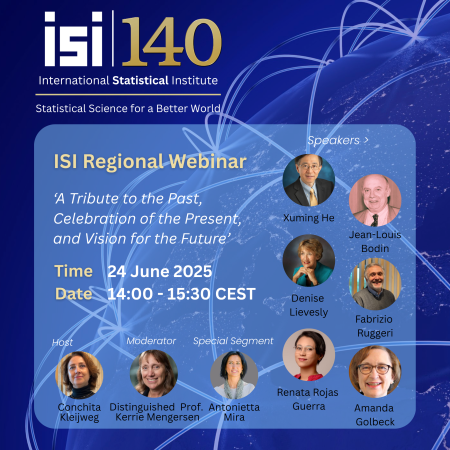
140 Years of ISI: This Number is Beautiful, Not Just Because We're Statisticians!
Figure The Joyful Celebration of 140 Year-Old ISI
By: Dr. Yi-Ju Jean Lee
Let's talk about 140—because if there's one thing we statisticians love, it's finding meaning in numbers! First off, 140 is a number with a remarkable number of divisors, making it a very "composite" and versatile number. This is perfectly fitting for an organization that brings together diverse minds from every corner of the globe! Just like 140's many factors, ISI's strength lies in its incredible variety of members, methodologies, and perspectives all working together.
But here's where it gets deliciously nerdy: 140 is also the sum of the first seven triangular numbers. If you're not a math geek, triangular numbers are those lovely sequences that form perfect triangles when arranged as dots. Seven triangular numbers building up to 140? That's basically the mathematical equivalent of ISI's journey—each decade building upon the last, creating something beautifully structured and endlessly fascinating.
From Top Hats to Laptops: The Wild Ride
Picture this: In 1885, when ISI first gathered, statisticians wore top hats and calculated standard deviations with slide rules. They probably never imagined that their intellectual descendants would one day analyze X sentiment in real-time or predict Netflix recommendations with mind-bending accuracy!
The transformation has been nothing short of magical. Those Victorian-era number-crunchers who painstakingly hand-tabulated census data would absolutely lose their minds seeing today's ISI members casually processing datasets with millions of observations before their morning coffee. Yet the core mission remains thrillingly unchanged: making sense of chaos, one dataset at a time.
Plot Twist: We've Always Been Superheroes
Here's something that might surprise non-statisticians—we've secretly been saving the world this whole time! During the 1918 flu pandemic, statisticians pioneered epidemiological modeling. In World War II, they cracked codes and optimized supply chains. During the space race, they calculated trajectories that literally shot for the moon. Today, they're the unsung heroes behind vaccine efficacy trials and climate change models.
Every time you check the weather, use GPS, or scroll through personalized recommendations, you're experiencing 140 years of statistical evolution in action. We're basically mathematical wizards, except our crystal balls are filled with regression equations and our magic wands are coding languages.
The Global Statistics Family Reunion
What makes ISI extraordinary isn't just its age—it's that it's probably the world's nerdiest, most international family reunion that happens to change the world regularly. Imagine a conference where a data scientist from Taipei bonds with a biostatistician from Lagos over their shared love of bootstrapping techniques, while a government economist from Ottawa debates sampling methods with an AI researcher from Mumbai.
This beautiful chaos of collaboration has produced some of humanity's most important statistical breakthroughs, proving that the best insights emerge when brilliant minds from different cultures tackle problems together.
The Next 140: Buckle Up!
As we rocket toward ISI's next century, the possibilities are mind-boggling. Today's new members might someday analyze data from Mars colonies or develop statistical models for time travel paradoxes.
So here's to 140 years of turning randomness into insight, uncertainty into confidence, and making the impossible measurable. Long live ISI—may your confidence intervals always be narrow and your p-values forever significant!
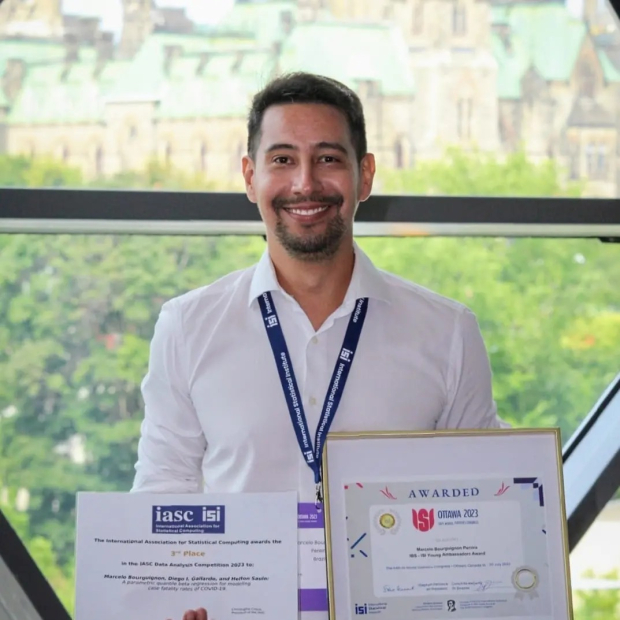
A Personal Reflection By Marcelo Bourguignon Pereira
A personal reflection and timeline of engagement with the ISI, showcasing how ISI has supported young statisticians over the years by Marcelo Bourguignon Pereira
_______
On June 24th, the International Statistical Institute will celebrate its 140th anniversary, and it is impossible to talk about my academic/professional history without mentioning the ISI.
Through the ISI awards, I had the opportunity to participate in the ISI World Statistics Congresses of 2017 (Morocco-Marrakech), 2019 (Malaysia-Kuala Lumpur), 2021 (online due to the pandemic) and 2023 (Canada-Ottawa). The ISI World Statistics Congress is the largest statistics event in the world and, for me, the best.
I had the honor of seeing Professor Sir David Cox receive the first International Prize in Statistics. This award is considered the Nobel Prize of Statistics. Then I had the honor of seeing Professors Bradley Efron, Nan Laird and C.R. Rao received their awards. Not only that, but I also received an award at the same event as them. During all these years with ISI, I had the opportunity to win 4 awards for young statisticians, in addition to being selected as an Elected member.
I am very grateful to ISI for the opportunities, learnings and experiences, and I hope to always be part of ISI. Long live ISI.
Below is a summary of my long relationship with ISI.
2017 - ISI Jan Tinbergen Awards (First Prize)
2019 - World Bank Trust Fund for Statistical Capacity Building
2020 - Boy propagating from ISIWSC21 (see image below :))
2021 - Elected Member of the International Statistical Institute
2022 - ISI-IBS Young Ambassador Awards
2023 - IBS-ISI Young Ambassador Awards
2024 - Young Statisticians Committee
2025 - Scientific Committee of the ISIWSC25 (unique in Latin America)
2026 - ISI Magazine Editorial Board
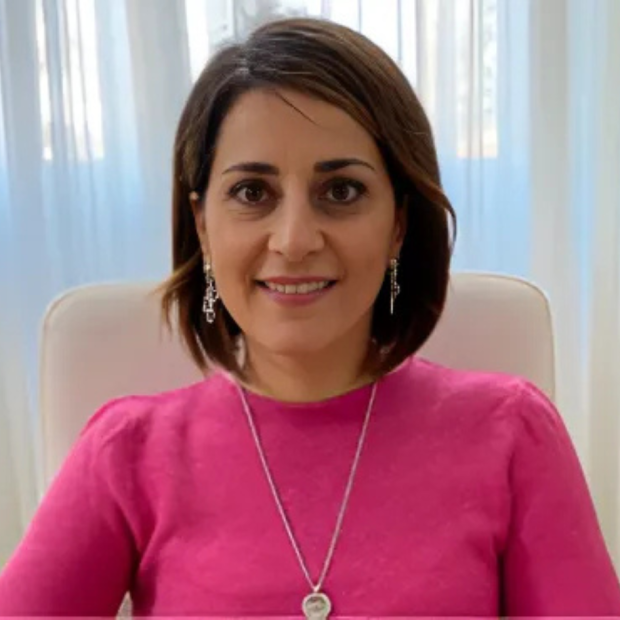
Congratulatory Message from Marica Manisera, Chair of the ISI Special Interest Group on Statistics in Sports
On behalf of the ISI Special Interest Group on Statistics in Sports, I am pleased to extend my warmest greetings to all the ISI members in occasion of the ISI’s 140th Anniversary. It is always inspiring to see the growing community of researchers, practitioners, and students who are advancing the use of statistical methods in sports. Through its activities and events, this community plays a vital role in fostering collaboration and innovation in our field.
We look forward to supporting your initiatives and hope to see many of you involved in future ISI SIG activities as well. Let us take this opportunity to celebrate the remarkable history of the ISI, and the vibrant spirit of our community that continues to move the field of statistics forward.
Statistics for a Sustainable Planet: ISI's 140-Year Legacy By: Dr. Yi-Ju Jean Lee
Without statistics, sustainability would remain an aspiration rather than an achievable goal. Every measurement, every target, every policy decision in the sustainability domain fundamentally depends on statistical methodology. As the International Statistical Institute (ISI) advances into its next decade, we must recognize that statistics is not merely supportive of sustainability efforts—it is the indispensable foundation upon which all meaningful environmental action rests.
Statistics as the Cornerstone of Environmental Understanding
Sustainability is fundamentally a measurement problem. Without precise quantification of environmental states, accurate assessment of intervention effects, and reliable prediction of future scenarios, sustainability efforts cannot transcend well-intentioned guesswork. Statistics provides the essential infrastructure for this quantification.
Consider carbon accounting, the foundation of all climate action. Every carbon footprint calculation depends on statistical sampling theory to extrapolate from limited measurements to population-level estimates. Life cycle assessments rely on uncertainty propagation methods to combine measurement errors across complex supply chains. Carbon offset verification requires statistical hypothesis testing to establish additionality claims. These are not peripheral concerns—they are the methodological requirements that make carbon markets and climate policy mathematically defensible.
The circular economy, perhaps the most promising framework for sustainable resource management, is entirely dependent on statistical modeling. Material flow analysis uses input-output models to track resource streams through economic systems. Waste stream optimization requires statistical process control methods. Product lifecycle extension strategies depend on survival analysis and reliability theory. Without these statistical foundations, circular economy initiatives would lack the quantitative framework necessary for implementation and evaluation.
The Statistical Architecture of Sustainable Systems
Renewable energy systems exemplify statistics' foundational role in sustainability. Wind and solar power generation forecasting relies on stochastic processes and time series analysis to predict energy availability. Grid integration of renewable sources requires statistical optimization methods to balance supply and demand variability. Energy storage sizing depends on extreme value statistics to ensure system reliability during rare but critical events.
Similarly, sustainable agriculture is built on statistical principles. Precision agriculture uses spatial statistics and geostatistics to optimize resource application. Climate-smart crop selection requires statistical modeling of weather patterns and their agricultural impacts. Soil health monitoring depends on sampling theory and experimental design to detect changes in complex biological systems.
Urban sustainability planning fundamentally relies on statistical methods. Smart city initiatives use statistical learning algorithms to optimize traffic flows, energy consumption, and waste management. Urban heat island mitigation requires spatial statistical analysis to identify intervention priorities. Sustainable transportation planning depends on statistical models of human mobility patterns and infrastructure performance.
Statistical Learning and Trustworthy AI
The relationship between statistics and artificial intelligence runs deeper than many practitioners recognize. While machine learning algorithms capture attention, the underlying statistical principles—from bias-variance tradeoffs to regularization techniques—determine their reliability and interpretability. The statistical research community has long emphasized the importance of statistical foundations in computational methods, positioning us uniquely to address AI's current challenges.
The works on algorithmic fairness, model interpretability, and uncertainty quantification directly addresses the trustworthiness concerns that limit AI adoption in high-stakes applications. When AI systems inform resource allocation decisions or environmental policy recommendations, the statistical rigor underlying these systems becomes paramount. ISI members are developing the theoretical frameworks and practical guidelines that ensure AI applications meet the standards of scientific evidence.
Methodological Innovation for Global Impact
ISI's sustainability extends beyond environmental considerations to encompass the long-term viability of statistical practice itself. The emphasis on open science, reproducible research, and collaborative international networks creates lasting value that transcends individual research contributions.
The shift toward computationally efficient statistical methods exemplifies this approach. As data volumes grow exponentially, ISI researchers are developing algorithms that maintain statistical power while reducing computational requirements. These methodological advances have immediate environmental benefits through reduced energy consumption and broader accessibility benefits through lower computational barriers.
Strategic Vision for Statistical Leadership
Looking forward, ISI's role in shaping sustainable development and responsible AI deployment will only intensify. The United Nations Sustainable Development Goals rely heavily on statistical indicators, and the emerging field of AI governance depends on statistical frameworks for evaluation and oversight.
Our international network positions ISI uniquely to establish global standards for statistical practice in these domains. Through the journals, conferences, and educational initiatives, ISI disseminates not just research findings but methodological best practices that influence policy and practice worldwide.
The statistical community faces an unprecedented opportunity to demonstrate that our discipline is not merely useful for sustainability—it is absolutely essential. Every environmental indicator, every sustainability metric, every policy evaluation depends on statistical methodology. ISI's leadership in this effort reflects our recognition that sustainable development is, at its core, a statistical challenge that requires the full depth of our methodological expertise and international collaborative capacity.
Written by: Dr. Yi-Ju Jean Lee – Senior Research Associate / PM of Smart Health, Taipei, Taiwan (ROC)
Where Numbers Tell Their Stories True
By: Dr. Yi-Ju Jean Lee
Celebrating 140 Years of the International Statistical Institute
In halls where numbers softly intertwine,
The International Statistical Institute's noble line,
Fourteen decades of truth unveiled,
Where data's voice has never failed.
From census counts to patterns deep,
Statistics wake the world from sleep,
Methods born from curious minds,
Hidden meanings in the data we find.
Variance whispers secrets of change,
Probability's dance, both wild and strange,
Correlation's silent song rings true,
Unraveling connections, old and new.
A century and forty years of light,
Guiding nations through day and night,
Turning chaos into clarity's art,
The science of numbers, our beating heart.
Here's to the stewards of statistical grace,
Shaping tomorrow with data's embrace,
Celebrating the past, the present, the quest—
For understanding, forever our best.

140 Years of the International Statistical Institute: A Legacy of Global Impact
In 1885, a visionary group of statisticians founded the International Statistical Institute (ISI)—a global platform for advancing statistical science and collaboration. Now, 140 years later, the ISI remains a beacon of statistical independence and innovation in a world increasingly shaped by data. It is a vibrant and committed community, powered by active members, dedicated officers, and our seven semi-autonomous associations that add even more energy through their own initiatives and events.
From 2009 to 2022, I had the privilege of serving as Director of the ISI. It was a time of rapid global transformation, during which the role of statistics became not only more visible, but more vital than ever. We worked to strengthen the ISI’s core pillars—such as the World Statistics Congresses—while broadening our global reach through initiatives focused on building statistical capacity in developing countries and supporting the use of statistics during times of crisis.
Throughout those years, I met an extraordinary number of people within the ISI and beyond—from every corner of the globe, from Africa to Asia, the Americas to Europe. I remain deeply impressed by the drive and dedication of so many, particularly those involved in organizing the World Statistics Congresses. Their boundless energy and commitment to excellence were truly inspiring. My role also led to rich exchanges with national statistical societies and numerous international and supranational organizations. Of course, there were challenges along the way—sometimes significant ones—but thanks to the dedication of the Executive Committees and ISI Permanent Office staff, we overcame them all. These experiences not only enriched my professional journey, but strengthened my belief in the power of international cooperation and open dialogue within our community.
A cornerstone of the ISI’s mission has always been its unwavering commitment to professional ethics. In an era of exponential data growth and algorithmic decision-making, ethical standards are not optional—they are essential. The ISI’s Declaration on Professional Ethics continues to serve as a global reference point, emphasizing that impartiality, integrity, and respect for privacy must guide everything we do.
Today, as statistics increasingly come under (political) pressure, the ISI’s role as a guardian of independence has never been more important. Facts must not be shaped by power; statistical integrity is a public good. The ISI is uniquely positioned to uphold professional standards, advocate for independence, and support statisticians worldwide in their pursuit of transparency and objectivity.
I have seen firsthand how colleagues navigate these pressures—sometimes subtle, sometimes systemic. These experiences have only deepened my conviction that protecting the independence of statistics is not only a professional duty, but a moral one. The ISI’s voice in this domain is vital, and I trust it will continue to speak out with clarity and courage.
This anniversary is both a moment of reflection and of renewed purpose. Our field faces new frontiers: the ethics of artificial intelligence, transparency in algorithmic systems, and the pressing need to foster data literacy across society. I am confident the ISI will meet these challenges with the same vision, independence, and spirit of collaboration that have shaped its work for 140 years.
I am deeply grateful to have been part of this remarkable journey—and proud to remain a member of a community that values excellence, integrity, and international cooperation.
Ada van Krimpen – ISI director 2009-2022

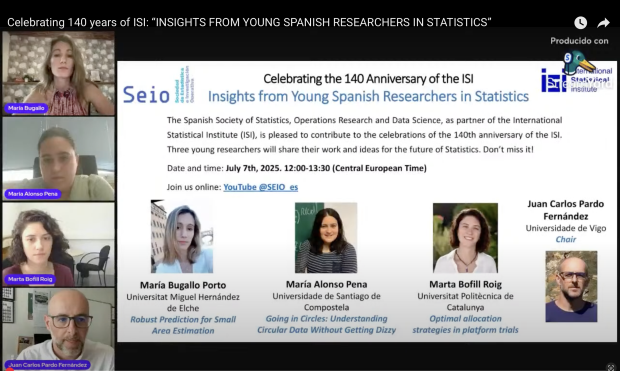
SEIO organised a webinar to celebrate the 140th Anniversary of the ISI
About The speakers:
- María Bugallo Porto (Universitat Miguel Hernández de Elche) – Robust Prediction for Small Area Estimation
- María Alonso Pena (Universidade de Santiago de Compostela) – Going in Circles: Understanding Circular Data Without Getting Dizzy
- Marta Bofill Roig (Universitat Politècnica de Catalunya) – Optimal Allocation Strategies in Platform Trials
The session was chaired by Juan Carlos Pardo-Fernández (Universidade de Vigo).
ISI: Bridging minds, shrinking distances
The 140 years of history of the International Statistical Institute represent merely the first chapter of a broader narrative that, throughout this century and a half, has witnessed the steady growth of memberships from every corner of the world.
Through ISI, we have the extraordinary opportunity to connect with researchers from different nationalities, delve into their innovative research, and actively contribute to interdisciplinary initiatives that encompass a wide range of scientific interests.
ISI’s influence has also manifested itself in the creation of small yet vibrant specialized scientific communities, such as the International Society for Business and Industrial Statistics, which have given rise to thematic groups capable of further strengthening the sense of belonging to a global scientific community. Within these contexts, researchers united by similar research interests gather together, having the opportunity to enrich their knowledge through fruitful exchanges of ideas and to be stimulated to pursue ever higher research standards.
All of this offers the unique opportunity to meet extraordinary people whom we would never have had the chance to know otherwise.
The Executive Committee and Council, along with all members of ISBIS, wish to extend their warmest and most heartfelt congratulations to ISI on this extraordinary milestone of 140 years of history.
This significant anniversary represents not only a moment of celebration but also an opportunity to reflect on the invaluable contribution that ISI has offered to the global statistical community over more than a century. Its legacy of scientific excellence and commitment to promoting international collaboration have shaped the landscape of modern statistical research.
Our most sincere hope is that ISI will continue to grow and flourish in the decades to come, increasingly strengthening its role as a beacon and indispensable point of reference for our global scientific community. May it continue to inspire new generations of statisticians and researchers, fostering innovation and excellence in research.
With deep gratitude for all that ISI represents and with our best wishes for the future.
Best,
The Executive Committee & Council and all Members of ISBIS