The International Statistical Institute is pleased to announce the fourth round of Elected Members for 2025. Please join us in congratulating these professionals, whose dedication and impact in the field of statistics and data science.
These individuals have been awarded the title of Elected Member of the International Statistical Institute.
Names and Country/Region of the Newly Elected Members
Brazil
- Pereira, Pedro Luiz Valls
Canada
- Golchi, Shirin
- Wang, Tao
Cyprus
- Artemiou, Andreas
Pakistan
- Khalil, Sadia
Portugal
- Vanda Lourenço, Marisa Rosa Milheiro
United States of America
- Green, Jennifer Lynn
- Shardell, Michelle
- Wagaman, Amy
- Young, Derek Scott
- Yu, Xiufan
Read some of our Elected Members' biographies below:
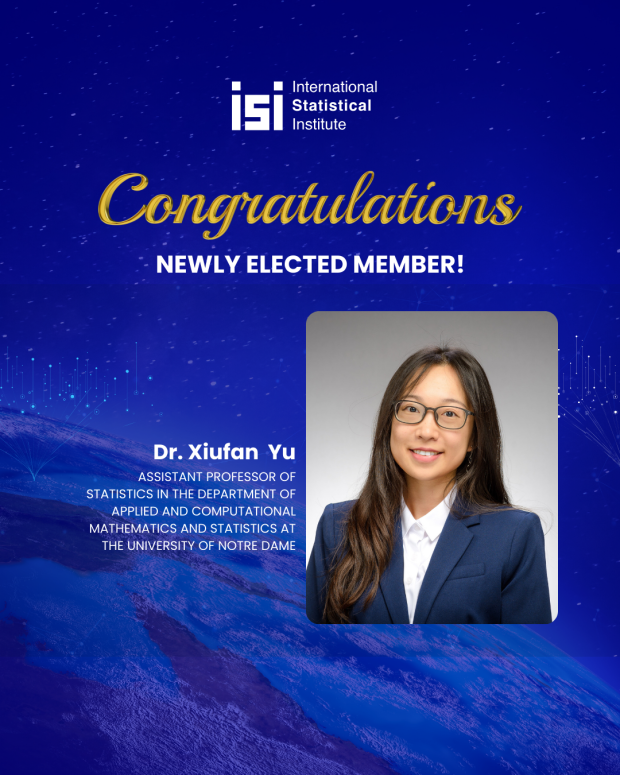
Dr. Xiufan Yu is an Assistant Professor of Statistics in the Department of Applied and Computational Mathematics and Statistics at the University of Notre Dame. She received her Ph.D. in Statistics from the Pennsylvania State University and B.Sc. in Statistics from the University of Science and Technology of China. Her research interests include high-dimensional statistical inference, causal discovery, factor models, and statistical machine learning.
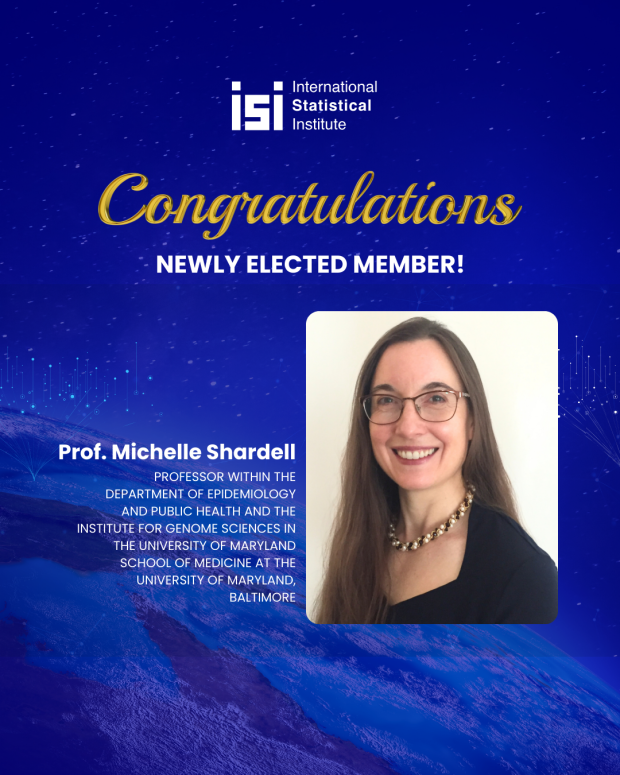
Michelle Shardell, Ph.D., is a professor within the Department of Epidemiology and Public Health (EPH) and the Institute for Genome Sciences in the University of Maryland School of Medicine at the University of Maryland, Baltimore (UMB). Additionally, she serves as EPH’s vice chair for research and is the director of EPH’s Division of Biostatistics and Bioinformatics. Dr. Shardell directs the Biostatistics Core of the UMB Institute for Clinical and Translational Research and co-directs the Biostatistics and Informatics Core of the University of Maryland Claude D Pepper Older American Independence Center.
Dr. Shardell’s research focuses on the nexus of geroscience and the biostatistics and epidemiology of aging. She develops and applies novel statistical methods to tackle challenging features of epidemiologic studies of older adults, including but not limited to truncation by death and the appropriate use of data from proxy respondents. Her research has resulted in over 210 publications in peer-reviewed literature. Dr. Shardell currently serves as the principal investigator of multiple projects supported by the National Institute on Aging and has also served as lead statistician on large multi-center research projects in aging.
In addition to her scholarship, Dr. Shardell is an elected fellow and active member of both the American Statistical Association (ASA) and the Gerontological Society of America (GSA). She served as co-convener of GSA’s Measurement, Statistics, and Research Design Interest Group and as a member of the Health Sciences section’s Fellows Review Board. Recently, Dr. Shardell served on the ASA Board of Directors and has been elected the 2027 Chair of Statistics in Epidemiology Section. In 2024, she co-founded ASA’s Statistics and Data Science in Aging Interest Group, where she served as the inaugural Program Chair.
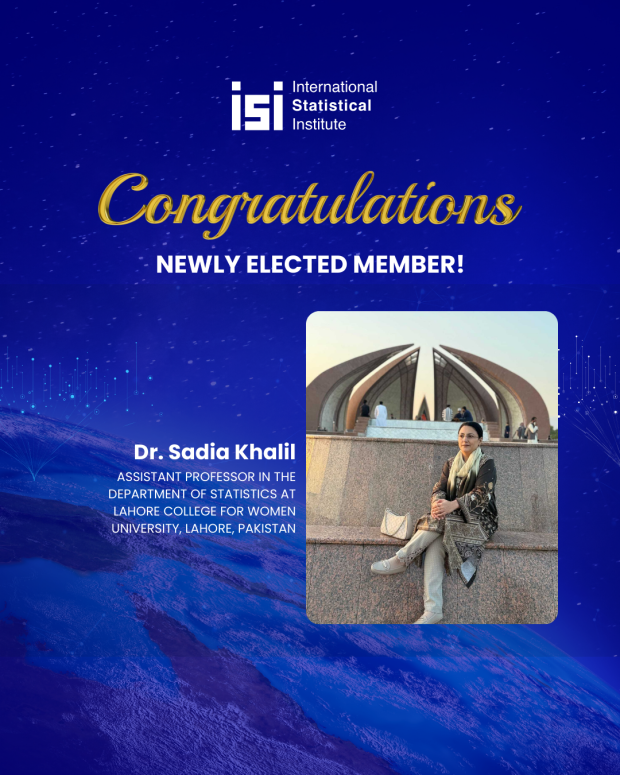
Dr. Sadia Khalil is an Assistant Professor in the Department of Statistics at Lahore College for Women University (LCWU), Lahore, Pakistan. She is also an Approved PhD Supervisor recognized by the Higher Education Commission (HEC) of Pakistan. With over 18 years of academic, research, and professional experience, she has developed an extensive research/teaching portfolio in survey sampling, particularly in randomized response techniques (RRT) and statistical methodologies for sensitive data.
From 2022 to 2024, Dr. Khalil served as a Visiting Assistant Professor in the Department of Mathematics and Statistics at the University of North Carolina at Greensboro (UNCG), USA. She has held a Courtesy Graduate Faculty appointment at UNCG since 2021, contributing to doctoral education and serving on multiple PhD dissertation committees. She has had multiple research visits and postdoctoral research under the mentorship of Professor Sat Gupta at UNCG USA.
Dr. Khalil served as a is co-investigator for a three-year National Science Foundation (NSF) grant (DMS-2244160) supporting a Research Experience for Undergraduates (REU) program at UNCG which was focused on complex data analysis and machine learning. She mentored and led several undergraduate research groups under this program. Dr. Khalil’s research has appeared in many international journals such as Communications in Statistics, Axioms, Mathematics, Journal of Statistical Theory and Practice, REVSTAT, and Journal of Interdisciplinary Mathematics.
She has delivered invited talks at major international conferences, including the Joint Statistical Meetings (JSM) and the International Conference on Advances in Interdisciplinary Statistics and Combinatorics (AISC). She has also organized and chaired numerous technical sessions on survey sampling and RRT models.
In addition to her research contributions, Dr. Khalil has actively served the academic community as an Associate Editor for the Journal of Statistical Theory and Practice, and as a reviewer for several international journals. At LCWU, she has held key administrative and academic leadership roles, including Coordinator for the MS Statistics Program, Doctoral Committee Member, and In-charge of Departmental Quality Enhancement Cell, LMS, and curriculum redesign.
Her teaching experience spans graduate and undergraduate courses in sampling theory, computational statistics, biostatistics, time series, inference, and categorical data analysis, both in Pakistan and the United States.
Dr. Sadia Khalil’s career reflects a strong commitment to advancing statistical science, fostering research collaboration, and mentoring emerging scholars. Her work continues to shape methodological innovations in survey sampling and sensitive data analysis.
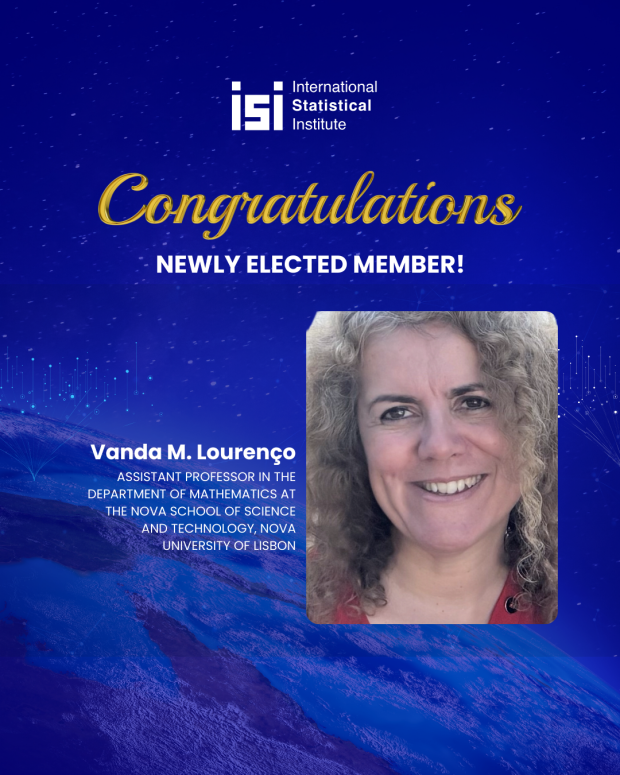
Vanda M. Lourenço is an Assistant Professor in the Department of Mathematics at the NOVA School of Science and Technology, NOVA University of Lisbon, and an active member of the NOVA Math research center, where she co-coordinates the thematic line Mathematics for Health and Biological Sciences (MatHBioS). She earned her PhD in Statistics and Stochastic Processes from Instituto Superior Técnico, University of Lisbon, in 2011.
Her research focuses on robust, non-parametric, and computational statistics, with particular applications in plant breeding, genetics/genomics, and the prediction of quantitative traits. Vanda is affiliated with several statistical societies, including the Portuguese Statistical Society, where she previously served as President of the Supervisory Board, and the Caucus for Women in Statistics, where she currently serves as Chair of the Country Representatives Committee and sits on several additional committees. She is also associated with the International Statistical Institute and the International Association for Statistical Computing. Additionally, she serves as an Associate Editor for the Journal of Data Science, Statistics, and Visualization.
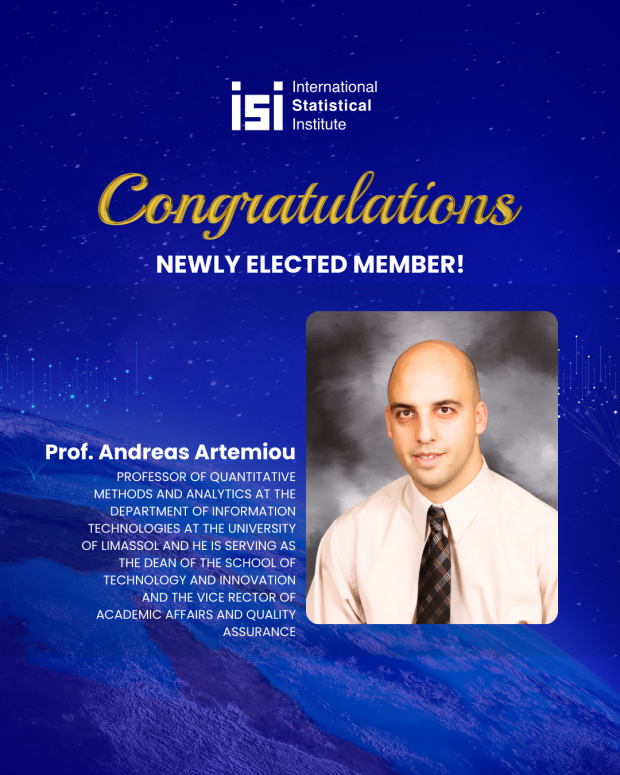
Prof. Andreas Artemiou is a Professor of Quantitative Methods and Analytics at the Department of Information Technologies at the University of Limassol and he is serving as the Dean of the School of Technology and Innovation and the Vice Rector of Academic Affairs and Quality Assurance. He has a BSc in Mathematics and Statistics with a minor in Computer Science from the University of Cyprus (2005), an MSc (2008) and a PhD (2010) in Statistics from Pennsylvania State University. He has served as Assistant Professor at the Department of Mathematical Sciences at Michigan Technological University (2010-2013), as a New Researcher Fellow at Statistics and Applied Mathematical Sciences Institute in North Carolina, USA (2012-2013) and as a Lecturer (2013-2019), Senior Lecturer (2019-2021) and Reader (2021-2023) of Statistics at the School of Mathematical Sciences at Cardiff University before joining the University of Limassol (2023-today).
His research interests are in methodological and applied statistics and more specifically in machine/statistical learning, high-dimensional statistics and kernel methods as well as applications of statistical methodology to other sciences with active collaborations with people in the Biosciences, Public Health and Medical Sciences. He has (co-)authored around 55 papers in peer review journals and he has (co-)supervised 7 research (6 Ph.D. and 1 MPhil) students to completion and currently (co-)supervises another 5 research (4 Ph.D. and 1 MPhil) students. His research has been funded from the National Science Foundation in the USA, the Welsh Government, the London Mathematical Society and the Wellcome Trust in the UK. He is serving as Associate Editor for Computational Statistics and Data Analysis. He is the Chair of the European Regional Section of the International Association of Statistical Computing.
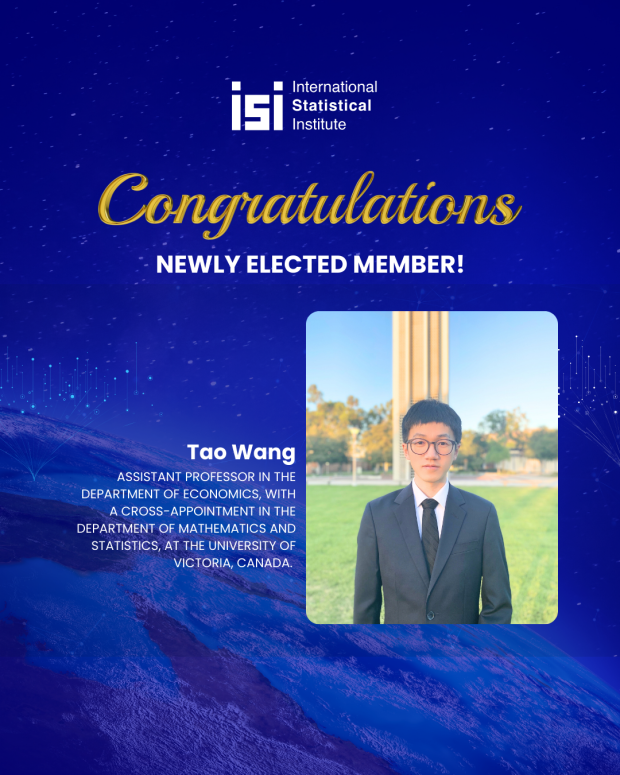
Tao Wang is an Assistant Professor in the Department of Economics, with a cross-appointment in the Department of Mathematics and Statistics, at the University of Victoria, Canada. His research lies at the intersection of econometrics, non-parametric statistics and machine learning. He focuses on advancing modal and mode-based regression techniques and integrating machine-learning tools into statistical frameworks for high-dimensional, complex and real-world data settings. His work has been published in leading journals in statistics and economics, including the Journal of Econometrics, Journal of the Royal Statistical Society Series A, Journal of Computational and Graphical Statistics, Electronic Journal of Statistics, Scandinavian Journal of Statistics and Statistica Sinica, among others. His research has received support from the Natural Sciences and Engineering Research Council of Canada (NSERC), the Social Sciences and Humanities Research Council of Canada (SSHRC) and other funding sources.
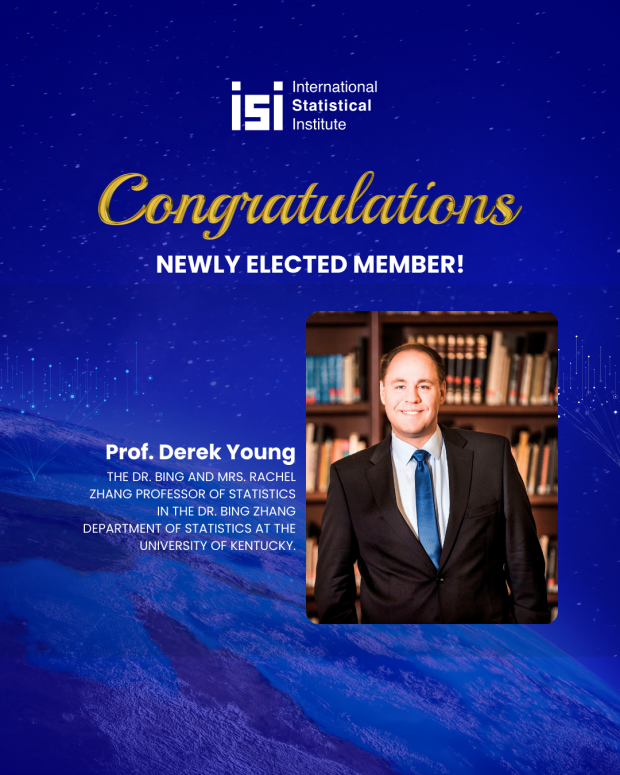
Derek Young is the Dr. Bing and Mrs. Rachel Zhang Professor of Statistics in the Dr. Bing Zhang Department of Statistics at the University of Kentucky. Prior to joining the University of Kentucky, he served as a Research Mathematical Statistician at the U.S. Census Bureau in Washington, D.C., and as a Senior Statistician at the Bettis Atomic Power Laboratory near Pittsburgh, Pennsylvania. He holds a B.S. in Mathematics (pure mathematics concentration with a statistics minor) from the University of Michigan and an M.S. and Ph.D. in Statistics from The Pennsylvania State University.
Derek’s research interests reflect his diverse professional background. His primary areas of focus include finite mixture models, tolerance regions, zero-inflated models, statistical computing, and non- and semiparametric methods. His secondary interests span applied survey methodology, data depth, data visualization, count models, and regression methods. He also maintains tertiary interests in astrostatistics, biomedical statistics, fiducial inference, statistical process control, and statistics education.
He has published over 50 peer-reviewed articles, advised 15 Ph.D. students, and developed and maintains four R packages—including the widely cited mixtools and tolerance packages. Derek is a member of the Institute of Mathematical Statistics (IMS) and the American Statistical Association (ASA), where for the latter he holds PStat® accreditation.
Why Become an ISI Elected Member and Why Nominate a Colleague
The International Statistical Institute brings together professionals who advance statistical science across sectors and around the world. ISI Elected Membership is more than a personal achievement. It is a recognition of excellence, a platform for influence, and a way to shape the future of our profession.
Why apply or accept a nomination
Elected Membership represents one of the highest professional honours within the international statistical community. It conveys credibility, leadership, and respect for your contributions.
It provides visibility beyond your institution or country, enabling connections with peers whose work is shaping policies, economies, and societies worldwide.
It offers the opportunity to influence initiatives, discussions, and collaborations that advance innovation across disciplines and borders.
It grants access to The International Statistical Institute's global network, events, and collaborations, creating new opportunities for research, partnerships, and impactful projects.
It stands as recognition that inspires others, demonstrating the value of statistical work to colleagues, institutions, and future generations.
Why Recommend Someone?
Many professionals underestimate the significance of their own impact. By nominating a colleague for ISI Elected Membership, you help highlight their achievements and ensure their voice is heard within the global statistical community. This act both celebrates excellence and strengthens the international network of leaders who are advancing the field.
Becoming, or recommending, an ISI Elected Member is not only about honouring past achievements. It is also about contributing to a future in which statistics continues to serve society, science, and decision making at the highest level.