
The International Statistical Institute is pleased to announce the second round of Elected Members for 2025. Please join us in congratulating these professionals, whose dedication and impact in the field of statistics and data science.
These individuals have been awarded the title of Elected Member of the International Statistical Institute.
Names and Country/Region of the Newly Elected Members
Australia
• Gunawan, David
Brazil
• De Souza, Rafael
China
• Guo F. Richard
Croatia
• Harmina, Anita
Hong Kong
• Yam, Sheung Chi Phillip
Saudi Arabia
• van Niekerk, Janet
Switzerland
• Sperlich, Stefan
United States of America
• Cattaneo, Matias D.
• Lu, Tang
Read some of our Elected Members' biographies below:
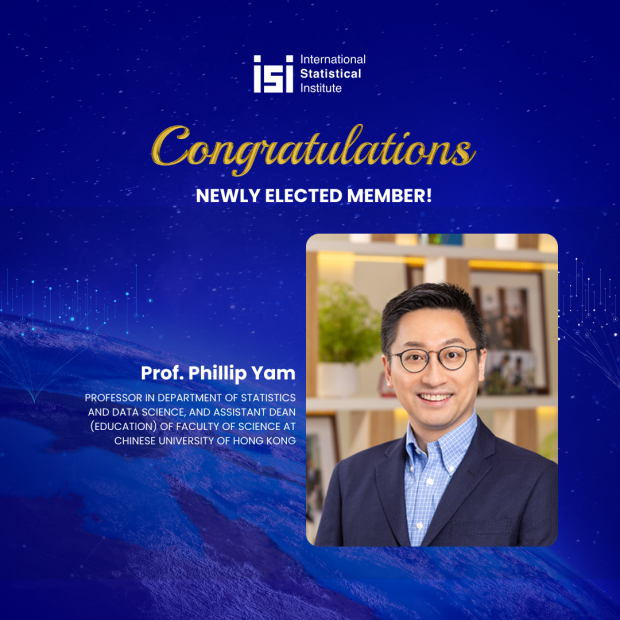
Phillip Yam received his BSc in Actuarial Science, with First Class Honours and Dean's Listings, and MPhil under supervision of Professor Hailiang Yang from the University of Hong Kong. Supported by the two scholarships awarded by the Croucher Foundation, he obtained an MASt (Master of Advanced Study) degree, Part III of the Mathematical Tripos, with Distinction in Mathematics from the University of Cambridge, and a DPhil in Mathematics under supervision of Professor Terry Lyons from the University of Oxford. During his postgraduate studies, he was also awarded the E. M. Burnett Prize in Mathematics from the University of Cambridge, and the junior research fellowship from The Erwin Schrödinger International Institute for Mathematics and Physics of the University of Vienna. Phillip is currently Director of the Quantitative Finance and Risk Management Science Programme, and a Professor at the Department of Statistics and Data Science of the Chinese University of Hong Kong (CUHK); he is also Assistant Dean (Education) of CUHK Faculty of Science. He was appointed as a research fellow in the Hausdorff Research Institute for Mathematics of the University of Bonn in Germany, a Visiting Professor in both the Department of Statistics of Columbia University in the City of New York and the Naveen Jindal School at the University of Texas at Dallas in the United States of America, as well as a Distinguished Visiting Scholar at the School of Risk and Actuarial Studies in the University of New South Wales in Australia.
He has published more than a hundred journal articles in actuarial science, applied mathematics, control theory and engineering, data analytics, financial mathematics and economics, operations management, probability and stochastic analysis, and statistics. He is currently an Editor of Insurance: Mathematics and Economics, a top journal in actuarial science, and also serves on editorial boards of several journals. Besides, he wrote the first ever monograph on mean field theory, Mean Field Games and Mean Field Type Control Theory, and another one called Financial Data Analytics with Machine Learning, Optimization and Statistics; one of his original research outputs included in the second book, “Comonotone-independence Bayes Classifier (CIBer),” was also awarded a Silver Medal in the 48th International Exhibition of Inventions Geneva in 2023. Besides, he has served as an external examiner for various funding institutions and universities in Hong Kong, Europe, North America, and Asia-Pacific regions, and a panel member of the selection committee for the Croucher Study Award. He has supervised over 30 postgraduate students and postdocs, many of them are now outstanding faculty members in world-renowned institutions, while others are expert practitioners such as quants and iBankers in financial and insurance industries, as well as international data analytics corporations.
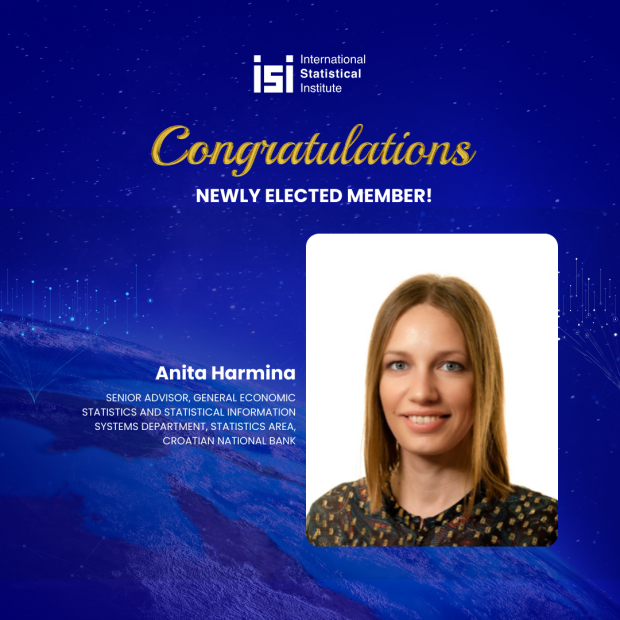
Anita Harmina is a Senior Adviser in the Statistics Area of the Croatian National Bank, where she leads the development and dissemination of experimental statistics related to climate change risks, household wealth, and distributional inequalities. In this role, she contributes to several expert groups coordinated by the European System of Central Banks (ESCB) and the OECD, supporting international efforts to advance statistical development and close data gaps.
Her professional background spans official statistics, applied research, and the teaching of statistics and mathematics. She previously worked at the Institute of Economics, Zagreb, on projects related to innovation and economic development, and at VERN University, Zagreb, where she taught undergraduate courses in statistics and mathematics for over a decade.
She holds a Master’s Degree in Mathematics from the Department of Mathematics, Faculty of Science, University of Zagreb, and a University Specialist Degree in Statistical Methods for Economic Analyses and Forecasting from the Faculty of Economics and Business, University of Zagreb. She is currently pursuing a PhD in the Interdisciplinary Doctoral Programme in Statistics at the University of Ljubljana, focusing on methodological issues in composite indicator construction for measuring technological transformation.
Her research interests include the development of official and experimental statistics methodology, the advancement and application of composite indicators, applied econometrics, structural equation modelling, and data integration and analysis.
She is a member of the Croatian Statistical Association and the Croatian Mathematical Society.
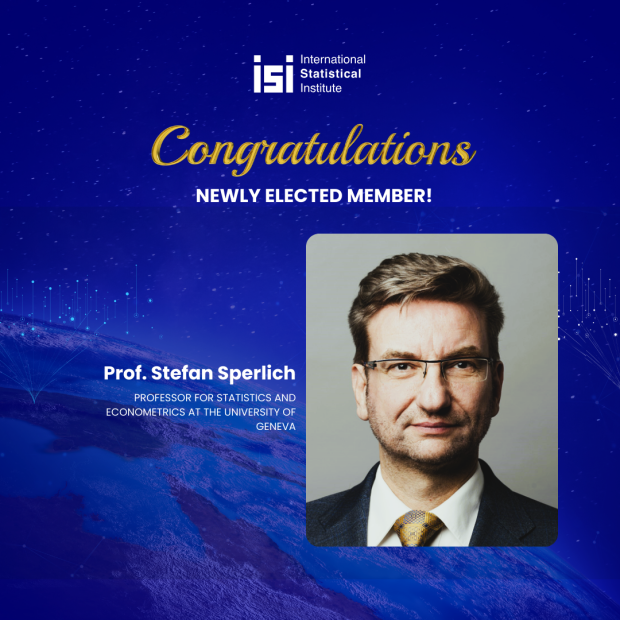
Prof. Stefan Sperlich made his diploma in mathematics at the University of Göttingen and holds a PhD in economics from the Humboldt University of Berlin. From 1998 to 2006 he was Professor for statistics at the University Carlos III de Madrid, from 2006 to 2010 chair of econometrics at the University of Göttingen, and is since 2010 professor for statistics and econometrics at the University of Geneva. His research interests are ranging from nonparametric statistics over small area statistics to empirical economics, in particular impact evaluation methods. He has been working since about 15 years as consultant for regional, national and international institutions, participated in development programs like EUROSociAL or UN assessment reports, was cofounder of the Courant Research Center 'Poverty, Equity and Growth in Developing Countries’ at the University of Göttingen, is research fellow at the Center for Evaluation and Development (Mannheim, Germany), and since 2014 founding director of the Research Institute for Statistics and Information Science at the University of Geneva. He published in various top ranked scientific journals of different fields and was awarded in 2002 with the Koopmans econometric theory prize, 2014 with the Augusto Gonzalez Linares and is Elected Member of the International Statistical Institute since 2025.
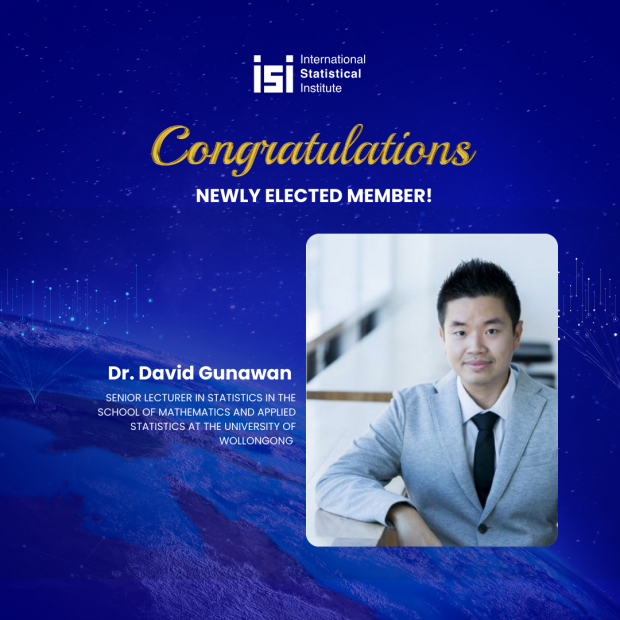
David Gunawan is a Senior Lecturer in Statistics in the School of Mathematics and Applied Statistics at the University of Wollongong. He received his PhD in Econometrics from the Department of Econometrics and Business Statistics at Monash University.
His research expertise spans spatial statistics, time series state space modeling, longitudinal panel data analysis, and Bayesian computational methods. He has developed and applied advanced Bayesian techniques to address significant applied problems across a wide range of domains, including environmental science, renewable energy, cognitive psychology, economics, health, and finance.
David has published in leading journals in statistics and related fields, including the Journal of Computational and Graphical Statistics, the Journal of Business and Economic Statistics, and the Journal of Econometrics. He is also a Chief Investigator on several Australian Research Council (ARC) grants.
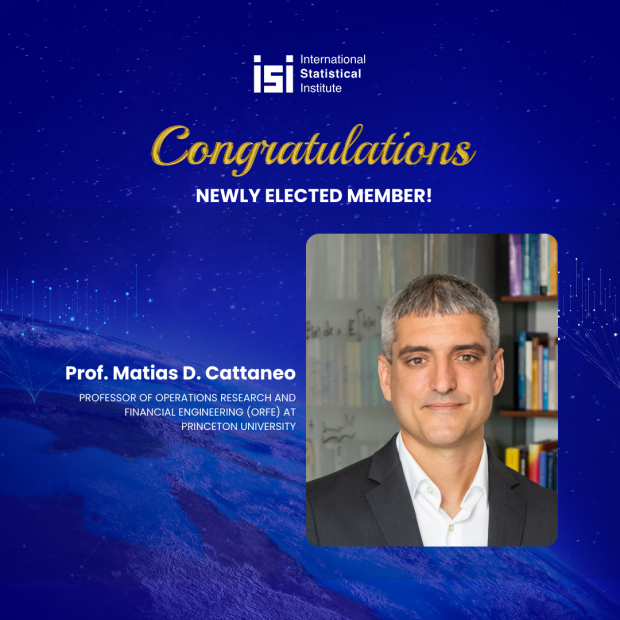
Matias D. Cattaneo is a Professor at Princeton University. His research spans econometrics, statistics, data science, and decision science, with applications to program evaluation and causal inference. His work is interdisciplinary, and often motivated by quantitative problems in the social, behavioral, and biomedical sciences. His research often integrates nonparametric, semiparametric, high-dimensional, and machine learning methods to develop robust estimation and inference techniques. Matias is an elected Fellow of the American Statistical Association, the Institute of Mathematical Statistics, and the International Association for Applied Econometrics. He earned his Ph.D. in Economics (2008) and M.A. in Statistics (2005) from the University of California, Berkeley, as well as an M.A. in Economics from Universidad Torcuato Di Tella (2003) and a B.A. in Economics from Universidad de Buenos Aires (2000).
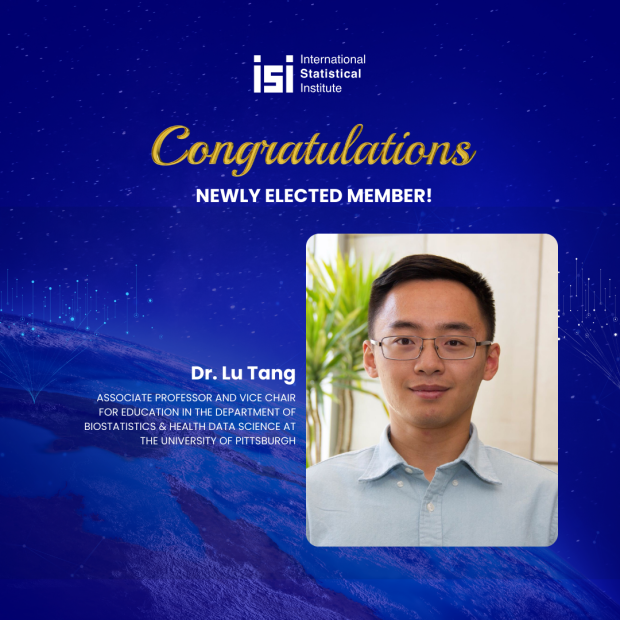
Dr. Lu Tang is an Associate Professor and Vice Chair for Education in the Department of Biostatistics & Health Data Science at the University of Pittsburgh. His research spans modern statistical methodology, machine learning, and health data science, with a particular emphasis on integrative analysis of heterogeneous data, federated learning, and individualized decision rules for precision medicine. Dr. Tang has published over 50 peer-reviewed articles in top journals and conferences across statistics, biostatistics, and machine learning, and has developed widely used open-source software. He has led federally funded research supported by the NIH and NSF and serves as a grant reviewer, journal associate editor, and organizer of international conferences. Dr. Tang's collaborative work in health policy and critical care medicine has informed opioid use disorder treatment policy and advanced sepsis care through data-driven decision models. As an educator, he has created innovative curricula and mentored award-winning students, furthering ISI’s mission of excellence in statistical education and global impact.
Janet van Niekerk is a Research Scientist at KAUST and affiliated with the University of Pretoria. Her research focuses on the computational aspects inherent to Bayesian methods, most notably the modern INLA framework, and models for biostatistical applications. She has worked on epidemiology, public health as well as joint models for clinical trials. She is an associate editor for Statistics and Computing. She is the co-lead of the Public Voice Consortium of the International Statistical Institute (ISI), the ISI's Young ambassador to the IBC for 2024/2025 and the webmaster for the ISI's Committee on Women in Statistics.
Why Become an ISI Elected Member and Why Nominate a Colleague
The International Statistical Institute brings together professionals who advance statistical science across sectors and around the world. ISI Elected Membership is more than a personal achievement. It is a recognition of excellence, a platform for influence, and a way to shape the future of our profession.
Why apply or accept a nomination
Elected Membership represents one of the highest professional honours within the international statistical community. It conveys credibility, leadership, and respect for your contributions.
It provides visibility beyond your institution or country, enabling connections with peers whose work is shaping policies, economies, and societies worldwide.
It offers the opportunity to influence initiatives, discussions, and collaborations that advance innovation across disciplines and borders.
It grants access to The International Statistical Institute's global network, events, and collaborations, creating new opportunities for research, partnerships, and impactful projects.
It stands as recognition that inspires others, demonstrating the value of statistical work to colleagues, institutions, and future generations.
Why Recommend Someone?
Many professionals underestimate the significance of their own impact. By nominating a colleague for ISI Elected Membership, you help highlight their achievements and ensure their voice is heard within the global statistical community. This act both celebrates excellence and strengthens the international network of leaders who are advancing the field.
Becoming, or recommending, an ISI Elected Member is not only about honouring past achievements. It is also about contributing to a future in which statistics continues to serve society, science, and decision making at the highest level.