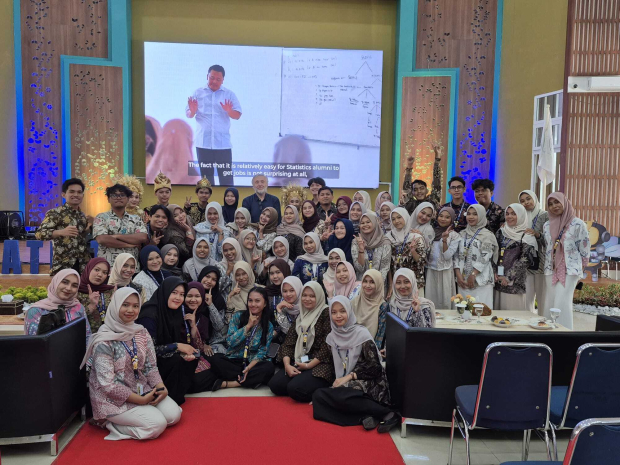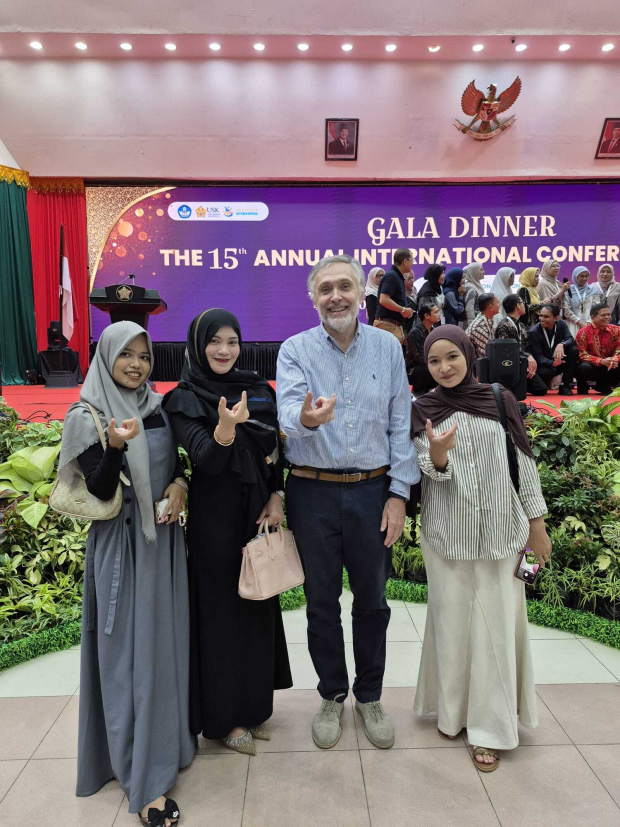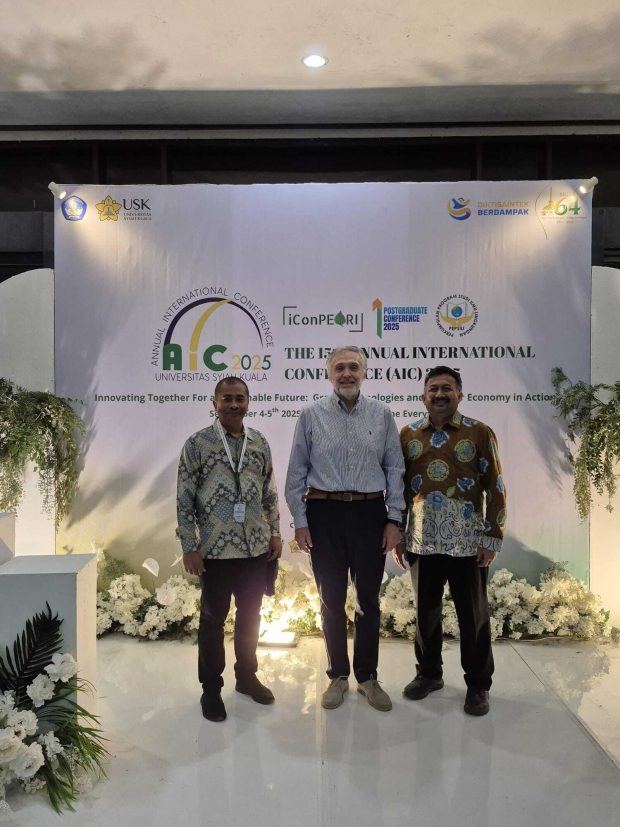
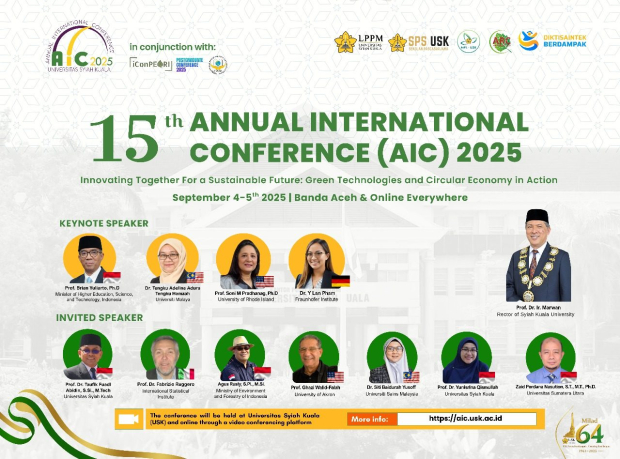
As part of the ISI Academy Mentoring Programme 2025, ISI President Fabrizio Ruggeri visited Syiah Kuala University in Banda Aceh, Indonesia. During his visit, he delivered a talk at the 15th Annual International Conference, where researchers and students from diverse fields gathered to discuss pressing environmental challenges. His presentation highlighted how statistics can be applied to address these issues and showcased the contributions of the ISI and its Associations.
Fabrizio also taught a Bayesian Statistics course, attended by 20 students in person and 50 students online from across Indonesia. In addition, he delivered three specialised talks and engaged in discussions with faculty members and students. Drawing on his extensive editorial experience, he provided guidance on preparing and submitting papers, offering valuable insights into the editorial process.
His visit concluded with a lecture on current trends in statistics at a two-day student-led event, which brought together participants from universities across Indonesia. Read all about it below.
_____________________
I just returned home after nearly three weeks at Syiah Kuala University in Banda Aceh, Indonesia. My visit was supported by the ISI Academy through its Mentoring Program, which aims to bring ISI members to give courses and lectures in countries classified as low- or lower-middle-income by the World Bank. This year, the Mentoring Program is supporting three visitors, providing only travel and accommodations (in my case, accommodations and most meals were kindly provided by the host university). After a request to ISI members to give a course in one of these countries, the lack of response (an issue to consider) prompted me to be one of the three speakers.
I began by giving a talk at the 15th Annual International Conference, which was attended by researchers from various disciplines. My talk focused on the usefulness of Statistics not only in itself but also in collaboration with other fields, and I emphasized the role played by ISI and its Associations in achieving these goals.
I then gave five lectures (3 hours each) on what I know best: Bayesian statistics, from basic concepts to Poisson and Markov chains, also using R for some examples. The course had 20 participants in the classroom and up to 80 online from all over Indonesia. Master's and doctoral students participated, along with young researchers. The course slides, codes, and R files were made available to participants in advance, and the lectures were recorded.
I also gave three research presentations on my most recent work (Concentration Function in Detecting Possible Fraud in Healthcare, Likelihood and Prior Robustness under Distorted Functions, Likelihood-Free Methods in Dynamic Queuing Networks) and one, aimed at students and young researchers, on the editorial process and tips for submitting papers.
I also gave a talk at Statistics Explore, a two-day event organized annually since 2018 by students and for students. Over 1,000 students (over 200 in attendance) attended the event, which featured numerous competitions in various fields of statistics and data science, including a category for high school students. My presentation focused on the role of stochastic models in the era of machine learning and artificial intelligence, providing insights for future research and challenges.
I also discussed potential joint work, particularly with two researchers on the possible Bayesian extension of their work on control charts and spatio-temporal models and provided some suggestions for their future research.
I also discussed the possibility of organizing a regional statistics conference in Indonesia again and realized there is great interest in it. The new ISI executive committee will discuss this possibility in due course.
My stay in Banda Aceh concluded with a visit to the stands at a fair organized by the University's students, with gazebos for each department/faculty and others selling food prepared by international students. It is a very vibrant and cutting-edge university, with many ongoing activities. I was also surprised (a typical Western preconception) by the number of female students, especially in Mathematics and Statistics, and by their enthusiasm.
My experience was incredible thanks to the hospitality of the hosts, especially Professor Hizir Sofyan (Chair of the ISI South-East Asia Outreach Committee), Professor Munawar Muchyen, two young researchers (Mardalena Selvi and Rumaisa Kruba), a student (Yolanda), Professor Zumila Marli Kesuma (Head of the Department of Statistics), and Professor Taufik Fuadi Abidin (Dean of the Faculty of Mathematics and Natural Sciences). I could name many others, and I apologize for those not listed. Everyone made my visit extraordinary, even from a social perspective. I was taken to see the city's main monuments and the Tsunami Museum, a reminder of what happened in Banda Aceh in 2004, from the disaster that claimed many lives to the reconstruction, thanks also to the collaboration of United Nations agencies and many countries around the world. I was able to sample locally produced and brewed coffee several times (especially Sanger), many typical Acehnese dishes (always with rice), and even tried pizza and pasta (sorry, but Italians cook them better!). I shared very pleasant moments with local colleagues, drinking coconuts on the shores of Sabang Island while admiring exotic (to me) fish, and a "classic" non-alcoholic mojito at sunset on one of Banda Aceh's beaches. It was a very intense visit, not only for the scientific aspects, but also for the pleasant social life I enjoyed (including meetings with the Rector and many of his assistants). A memorable experience.
This year's Mentoring Program was experimental. After the conclusion of the other two experiences (Paulo Rodrigues Canas in the Philippines and Kerrie Mengersen in Vietnam), the ISI Executive Committee will evaluate the results of the three visits. In my opinion, this is an experience worth continuing (along with other online ones), but it requires financial support and ISI members willing to lead courses. A special fund could be created to support activities like this, and this is a topic worth discussing, also involving the ISI community.
See photos from the Syiah Kuala University here: